Every Boat Is an Argument With Water
Hull shape is a list of things you have agreed to give up, and I once gave up the wrong one by five inches.

The worst boat I ever built is still afloat, and I see her most Sundays.
She’s a seventeen-foot lapstrake pulling boat, cedar on oak, built for a retired Latin teacher named Hester Quill. Hester wrote out what she wanted on an index card, which I still have. She wanted to row for exercise. She wanted a small outboard for coming home against the ebb. She wanted a boat a seventy-year-old could climb back into from the water, and one that would carry Bishop, who was mostly Newfoundland and weighed a hundred and ten pounds.
Any one of those is a reasonable thing to want. Put them on the same card and you have a fight.
What the water charges
Width makes a boat stiff. Stand on the rail and she stays put. But width means more skin in the water and a fatter shape to shove aside, and you pay for that on every stroke. A flat bottom sits quiet at the dock and slams in a chop. A deep V goes through the chop and rolls at the dock until your coffee is in your lap. Curve the keel up at both ends, which we call rocker, and she’ll spin on a dime and wander off when you stop paying attention. Straighten it out and she tracks like a train, and you’ll want a town meeting to turn her around.
Then there’s length, which you can’t argue with at all. A boat pushing through water makes a wave at the bow and another toward the stern. The faster she goes, the longer that wave gets, until she’s sitting in a trough of her own making with her stern sinking into it. The old figure is 1.34 times the square root of the waterline in feet, and that gives you knots. Sixteen feet of waterline, about five and a third. You can bolt on more engine. Mostly you’ll get more noise.
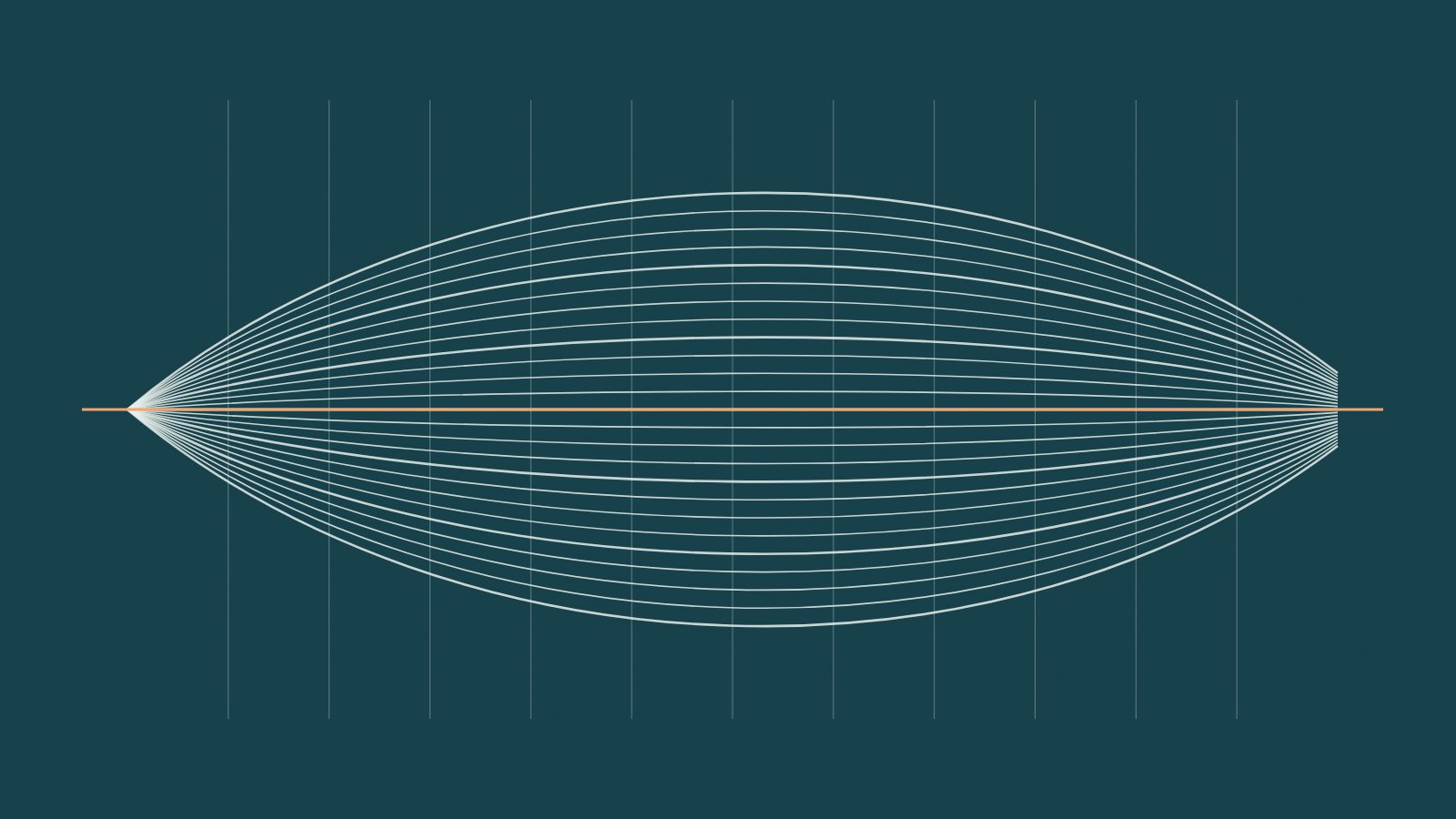
So you draw. A lines plan shows one hull three ways: from the side, from above, and in slices, as if you’d sawn her like a loaf. Every point on the hull has to land in the same place in all three views. Lift one curve and two others go wrong. That’s what makes the drawing honest. A bad idea shows up as a lump.
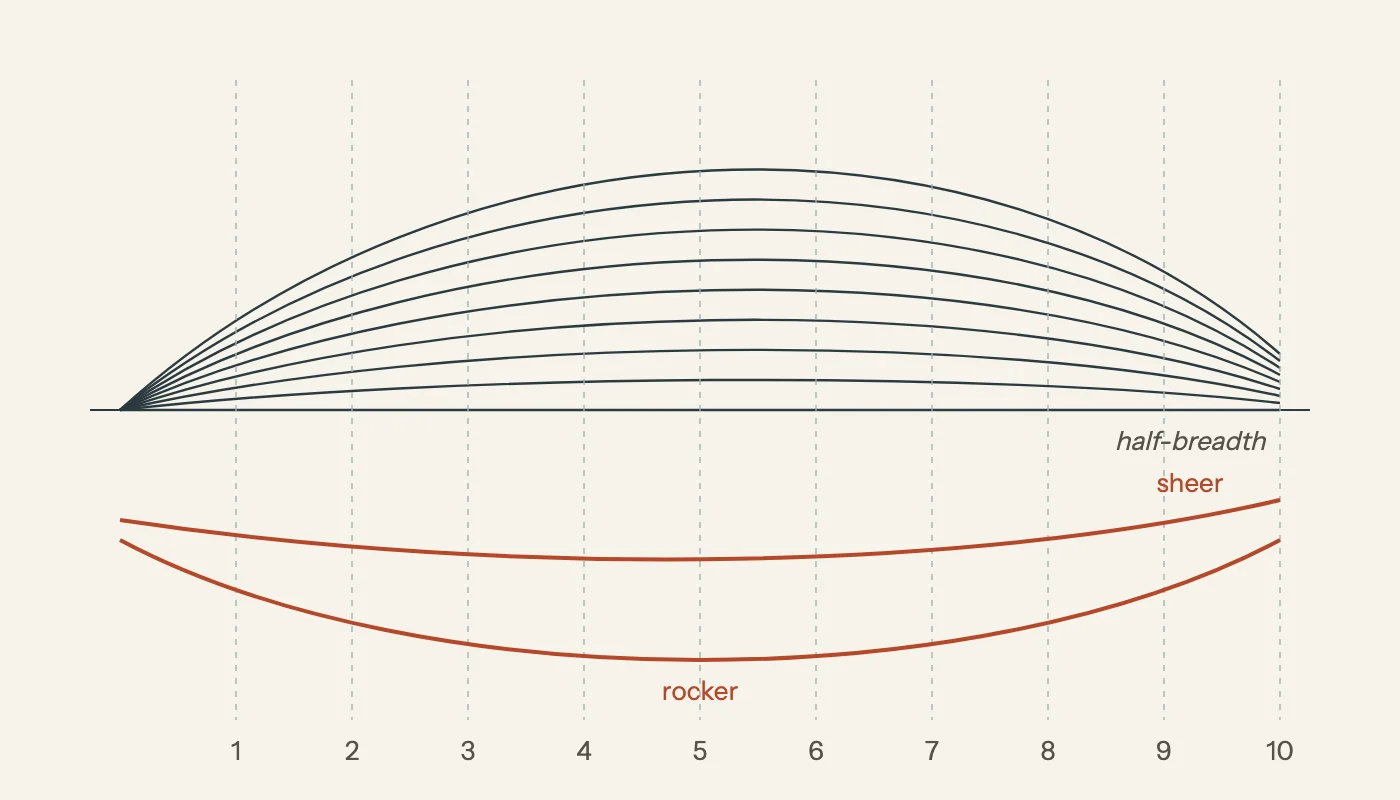
That’s the plan I drew her. Narrow on the water, a long easy run aft, the stern lifting clear so the water could close up behind her without any fuss. It was the best set of lines I’d done. I pinned it on the shed wall for a while, which I don’t usually do.
Five inches
Then I got to thinking about the outboard. Thirty-five pounds hung off the very end. Add Hester, sitting aft to run it, and Bishop, who went where Hester went. I worked out the weights and saw the stern would squat.
So on the lofting floor, with the lines laid out full size and the battens tacked down, I let the last three stations out. Five inches more beam at the transom, and I dropped the transom lower to carry the load. I climbed up in the rafters and looked. Still fair. A batten will go sweetly through a lot of bad decisions.
We launched her in June. She floated dead on her marks, weight and all, and that pleased me for about a minute. Then I rowed her out past the fuel dock.
A wide, low transom sits in the water. The water can’t close up behind it, so the boat drags a piece of the harbor along. At three knots I could look astern and see it, a flat boiling patch the width of the boat, following me like a bad debt. She rowed like a bathtub with ambitions. In a following sea that fat stern got picked up and shoved, and she’d try to swap ends.
I had solved the problem I could calculate and bought one I could only feel. Four hundred hours in that hull, give or take.
I drove out to Hester’s and told her. I offered to build her another at my own cost, with the first stern, and to talk her out of the motor. I don’t offer that lightly. She said she’d take the boat out for two weeks and report.
The report came on an index card. Rows poorly. Feels very safe. Bishop went over the side after a cormorant on Tuesday and I hauled him in across the transom without shipping a cupful. I decline your kind offer. I am not in a hurry and neither is he.
I was sore about that for a year. I’d have preferred she yell.
That boat isn’t in the photographs on my shed wall. I’ve built thirty-one since, and I’ve looked hard at every stern, and I’ve drawn better lines than Hester’s and ruined none of them on the floor. A few of those owners have told me their boats are a little tender when the dog moves around.
Bishop’s been dead four years. There’s a new dog, smaller, with worse manners. Most Sundays around ten she comes up the channel on the flood, not hurrying, with that patch of bad water following her all the way in. She waves. I wave.
Then I look at the transom. Five inches.