Desire Paths Are the Most Honest Urban Plan
A strip of dead grass in Tolliver Park beat a sign, a rope, a hedge, and a drainage study


The most reliable survey my city has ever conducted was done by feet, for free, mostly in the rain.
It took place in Tolliver Park, a rectangle of grass in Calloway about 400 feet by 300, laid out in 1926 with a paved loop around the edge and a formal cross through the middle. At the southeast corner is the Route 6 stop at Ash and Fourth. At the northwest corner is the main door of the community college, which did not exist in 1926 and has been inconveniencing the park ever since. Between them, running corner to corner, was a bald stripe of dirt two feet wide that nobody ever approved.
I’m a transit planner. Parks are not my department, as the Parks Department has reminded me. But that stripe ended at my bus stop, so one Tuesday in October I stood at the corner with a clicker from 7 a.m. to 7 p.m. and counted. 612 people took the dirt. 71 took the pavement.
The math isn’t mysterious. Going around the edge from corner to corner is 700 feet. The diagonal is 500, because the 3-4-5 triangle is the one thing from tenth grade that has never let me down. That’s 200 feet saved, about 45 seconds at an ordinary walking pace. Forty-five seconds sounds petty until you remember that back then the 6 came every thirty minutes. Nobody was ruining the lawn for fun. They were ruining it because the 7:42 left at 7:42, and the next one would make them late to a job that docks you for it.
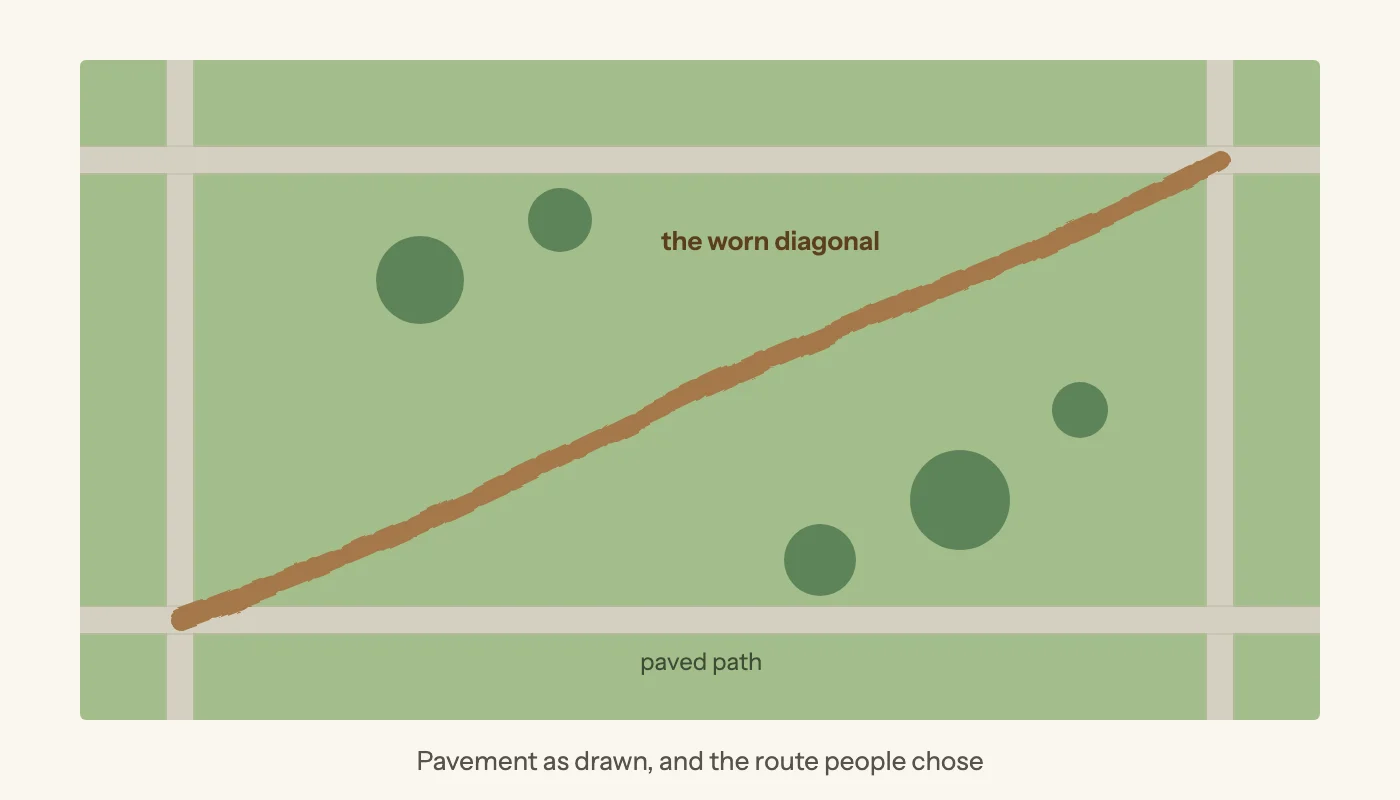
Planners call this a desire path, which is by far the most romantic term in a profession that also says “curb radius.” Parks called it turf damage, and over six years they tried the following.
A sign, in 2016. Please Keep Off the Grass, in English and Spanish. Someone added “why” in ballpoint.
Reseeding and a rope fence, in 2017. The rope was gone in nine days. The stakes stayed, and people walked between them like a slalom.
A hedge, in 2019, forty feet of barberry across the worst stretch. The path grew an elbow and went around it. By the next spring there was a gap in the barberry exactly the width of one college sophomore.
A drainage study, in 2021, because the stripe had become a trench that held water until May. It cost $14,000 and concluded that the stripe was holding water.
I have some sympathy, having spent my own career arguing with facts. But I envy that stripe. If I ask people at a public meeting how they would like to get to campus, I hear from eleven retirees and a man with a laminated map, each telling me what he believes he would do. The dirt recorded what people actually did, half asleep, with a backpack, in February. No neighborhood association could stack it.
In 2022 Parks finally proposed paving the thing, and we held a hearing. Mr. Penhale of the Friends of Tolliver Park rose to say that a diagonal would violate the park’s original geometry. That geometry has been visible since the Coolidge administration only to pigeons, a point I made later, in the hallway, to nobody.
Then a woman named Ruth Amsel got up. She uses a walker, and she’s the reason I don’t get to be smug about dirt. Ruth had been taking the long way for nine years, all 700 feet of it, because the stripe was a rut in good weather and a moat in bad. She had never once registered in my count as someone who wanted the diagonal. Neither had anyone in a wheelchair, or the students who wouldn’t cross an unlit park at 9 p.m. I had been waving those 612 clicks around for months as if they were the voice of the people. A desire path is honest, but only about the people already able to walk it.
That changed the project. What got built in 2023 was eight feet of gently graded concrete with two light poles, for $61,000. Ruth took it the first morning and informed me that it was 200 feet shorter, in case I hadn’t heard. I went back on a weeknight and counted 40 people crossing after dark, where I had once counted six. Mr. Penhale, to his credit, now leads the spring walking tour and refers to it as “the 2023 axis.”
There is one more thing to report. The engineers, being engineers, straightened it. The old stripe had a slight bulge around the roots of an oak, and it came into the corner at an angle, aimed at the spot where the front door of the bus actually opens, about thirty feet past the pole. The new path runs dead straight from curb ramp to curb ramp. On a plan it’s a lovely line.
Last April I noticed the grass near the stop looking thin. By July there was a stripe, a foot wide and thirty feet long, peeling off the new concrete at a shallow angle toward the bus door.
I called Parks. They asked whether I could do anything about where the bus stops.