The Tide Table on My Kitchen Wall
A free sheet of paper from the harbor office runs my working life, and I have stopped arguing with it.


The tide table on my kitchen wall cost nothing and has been right more often than anyone I’ve married.
The harbor office in Port Alder prints them every December. One sheet, both sides, a block of numbers for each month. Four times a day, give or take, and a height beside each. Dolores at the chandlery keeps a stack by the register. She’ll give you one if you buy a box of bronze screws, and also if you don’t. Mine hangs on a nail by the stove, where it picks up grease and pencil.
I build small boats in a shed at the bottom of Cooper Lane. The shed has a ramp. The ramp goes into the harbor, and the harbor empties twice a day. On a big spring tide we lose fourteen feet of water in about six hours. What’s left at the foot of my ramp is ninety yards of gray mud that will take your boot and keep it.
So I don’t decide when things happen. I look at the wall.
Today says low at 3:41 in the morning, high at 9:52, low at 4:04, high at 10:17. I can launch from about eight until a little before noon. If I want to go scrape the mooring chain, that’s the afternoon low, and I’d better have my boots on by three. Planking and glue go wherever they fit. A kid from the high school asked me once what all this meant, so I drew him a day.
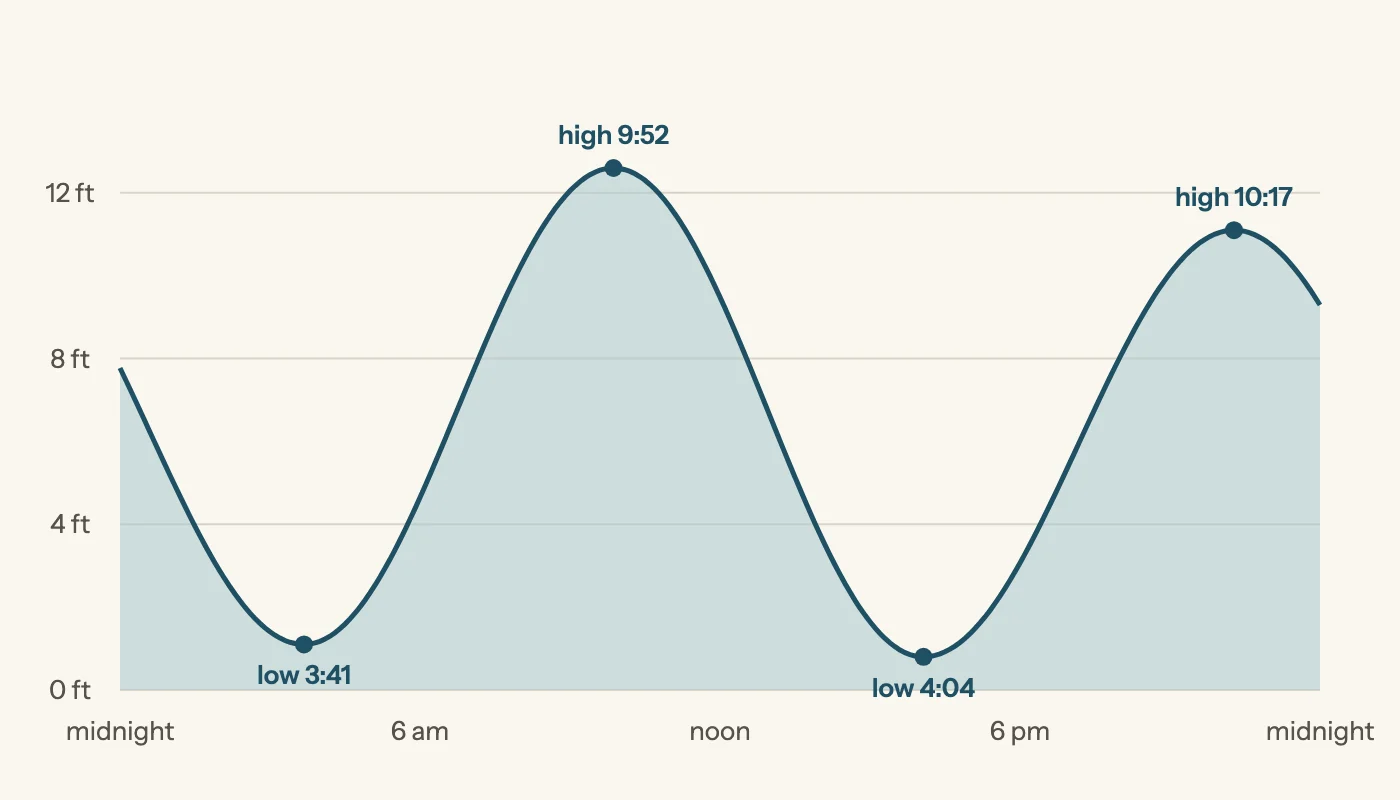
Notice the highs don’t match. People from away assume a tide is a tide. That morning’s stood at 12.6 feet and the evening’s at 11.1. Nothing holds still on the clock, either. The whole schedule slides about fifty minutes later every day, because the moon keeps moving along while we spin underneath it, and it takes us that much longer to catch up. Monday’s ten o’clock high is twenty to twelve by Wednesday. Around the full and new moons the range opens up. Halfway between, at the neaps, it closes to about nine feet.
There’s an old rule for the hours in between. The water moves one twelfth of its range in the first hour, two in the second, three in the third, three in the fourth, then two, then one. It’s crude and it’s good enough. On a fourteen-foot tide you lose three and a half feet in that third hour. People tend to learn about the third hour with a boat on a trailer.
The table is printed in standard time. It says so at the top in small type, and has since before I was born. From March to November you add an hour. I have known this for twenty-six years.
Four summers ago I told a dentist named Alan Pruett to bring his family down at nine on a Saturday to launch the sixteen-foot skiff he’d paid me eleven thousand dollars for. I read the number off the wall in a hurry with toast in my hand. Nine it said, so nine I told him. It was a neap. True high was ten, and an hour short of the top my ramp was nine inches shy of floating her.
They came with a bottle of something and a mother-in-law. We stood on the ramp beside a dry boat on a trailer and watched the water come up at its own speed. It took an hour and ten minutes. Alan’s mother-in-law asked whether this was part of it. I said yes.
The table can be wrong without any help from me. It knows the moon and the sun. It doesn’t know the weather. The sea rises about a foot for every inch the barometer falls, and a day of southerly will push more on top of that. I’ve had water in the shed on a tide the sheet called ordinary. I keep the lumber up on blocks and I don’t hold it against anybody.
My sister lives in the city and runs her life from a phone that pings. She’s busy, and I believe her. She spends a good part of every week moving things around, because everything in her week can be moved. There’s a person at the other end of each item who can be asked. I couldn’t do it. I’d be asking all day. My own schedule was set some time ago by a rock the size of a continent, a quarter of a million miles off, and there’s a kind of rest in that. Nobody has ever called the harbor to ask for Thursday instead.
I keep the old sheets in the drawer with the string. Twenty-six of them, and the margins have gotten to be the only diary I’ll ever keep. Hauled Marigold. Cedar came. Mud. There’s a Tuesday in March of 2014 with a time circled, 4:10 in the afternoon, and no word beside it.
That was my father. The old men at the co-op will tell you a person goes out on the ebb. They said it to me at the funeral, kindly, over the ham. I went home and looked it up, because the sheet was right there. Low that day was 2:02.
He went two hours into the flood. Contrary to the last.