How to See the Andromeda Galaxy From a Parking Lot
All you need is cheap binoculars, a lawn chair, and a dumpster to stand behind.

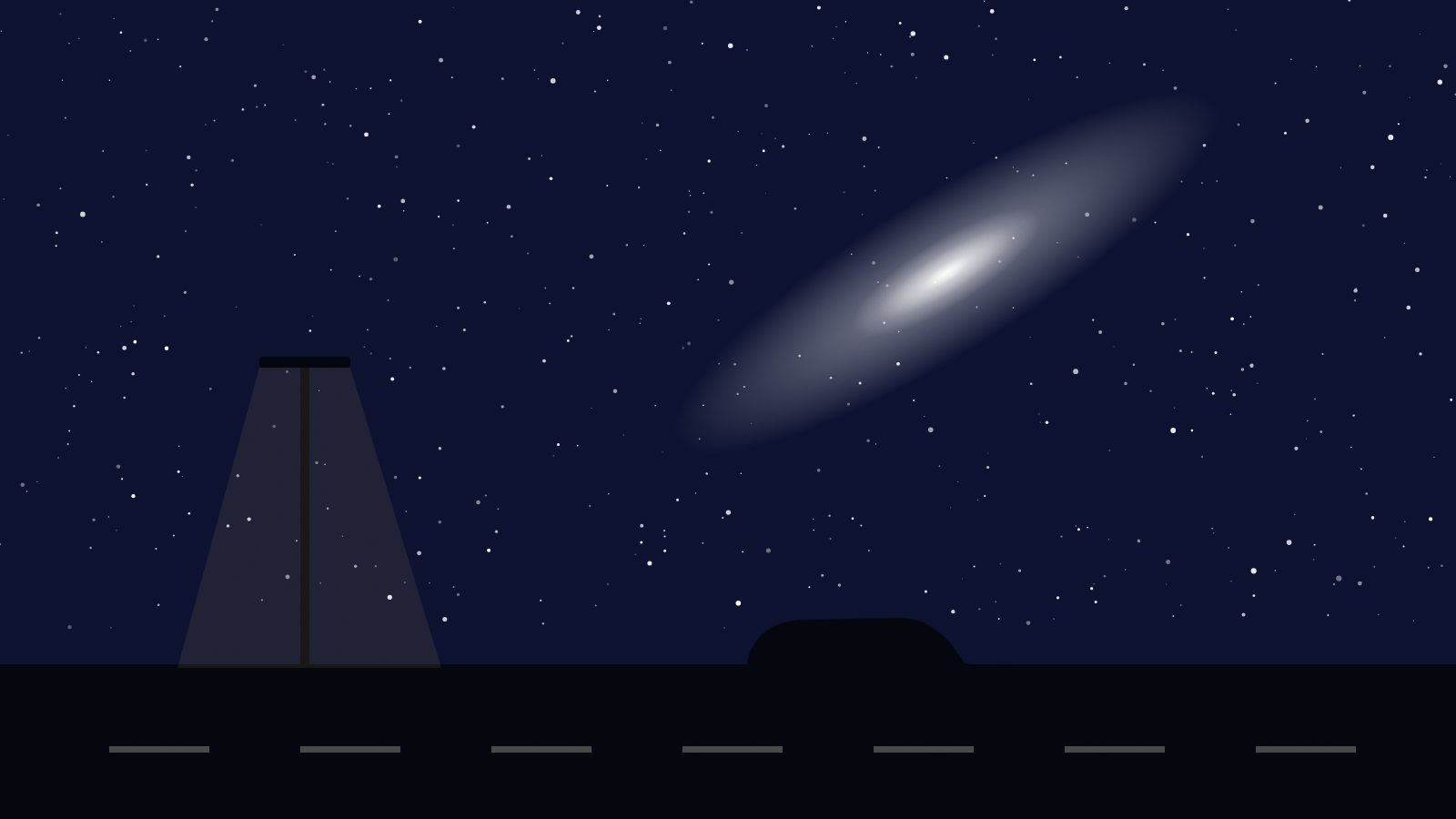
The most distant thing most people will ever see with their own eyes is visible from the back row of the Ansel Fresh Foods parking lot, provided you park by the dumpsters.
I started going there because my backyard has a neighbor with a floodlight and a grudge. I keep going because my students believe astronomy requires a mountain. A mountain would help. But the Andromeda Galaxy is bright enough and big enough that hardware-store binoculars can pull it out of suburban glow, and once you’ve found it, you will know where it is for the rest of your life.
What to bring
Binoculars come first. A 7x50 or 10x50 pair is ideal, and whatever is in your hall closet is fine. Bring a reclining lawn chair too, because Andromeda climbs nearly overhead on autumn evenings at Midwestern latitudes and your neck will file a complaint. Rubber-band some red cellophane over a flashlight. Go in the stretch around new moon, when the moon is out of the evening sky.
Your eyes need twenty to thirty minutes in the dark to reach full sensitivity, while your rod cells rebuild the pigment that bright light bleached out. A parking lot will never get you all the way there, but you want every bit you can get. Stand with something solid between your face and the nearest light pole. That is the real function of the dumpsters. Put your phone in the glove compartment, because one glance at it will undo a good part of your work.
The hop
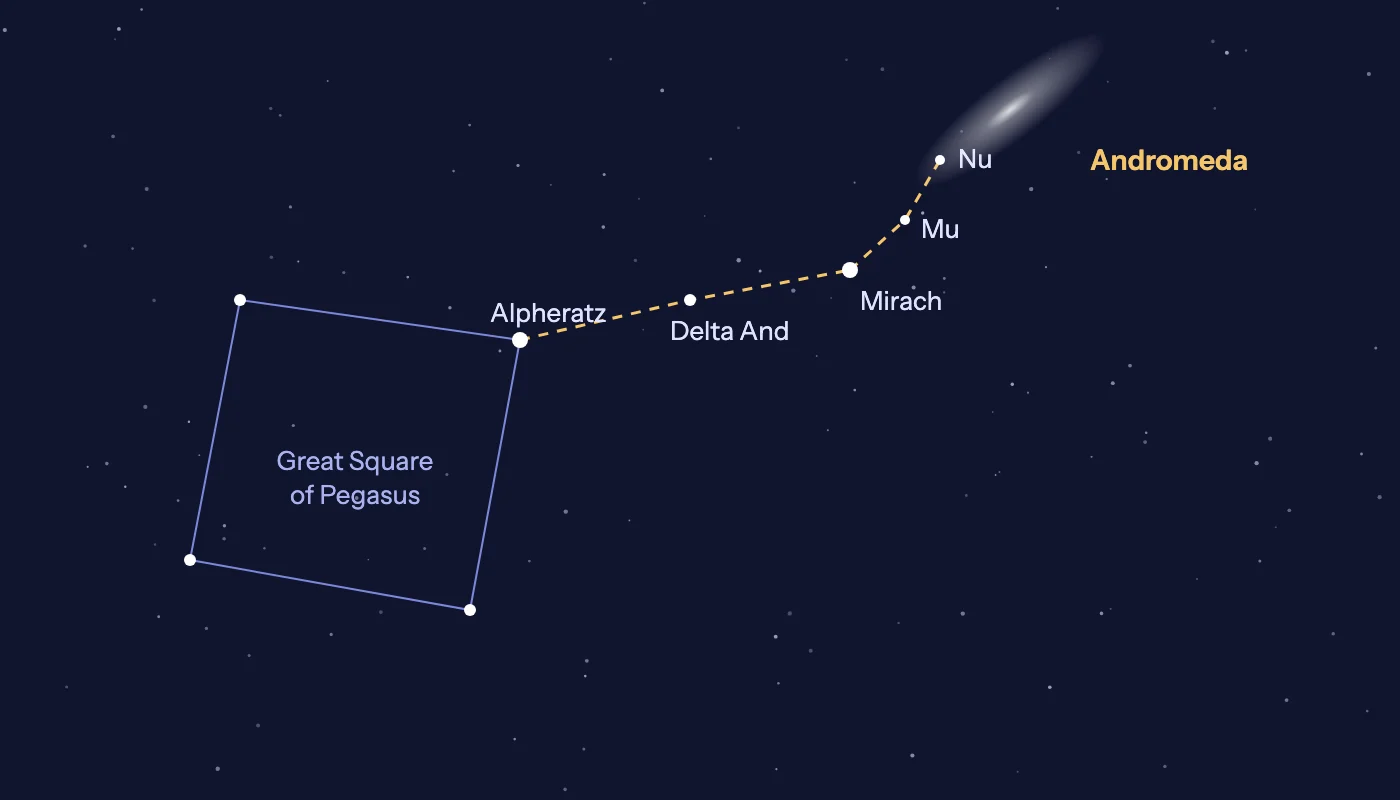
Around nine in the evening in late October, the Great Square of Pegasus sits high in the southeast, tipped a little onto one corner. It’s big, about a fist and a half on a side at arm’s length, and people miss it because they’re looking for something small.
Find the Square. You want four stars of similar brightness with almost nothing inside them.
Find Alpheratz, the upper-left corner. Officially it belongs to the constellation Andromeda, and Pegasus has been borrowing it for a couple thousand years.
From Alpheratz, follow a chain of stars to the left and slightly up. First comes Delta Andromedae, noticeably dimmer, most of a fist away. Most of a fist beyond that is Mirach, as bright as Alpheratz and faintly orange in binoculars.
Get Mirach in your binoculars and turn toward Cassiopeia, the lopsided W higher in the northeast, leaning a little back toward the Square. Two fainter stars step away from Mirach in that direction, Mu Andromedae and then Nu Andromedae, each three or four degrees from the last. Put Mirach at the edge of your view and Mu will be in the middle of it.
Slide over until Mu sits where Mirach was. Nu is now in view. Just past Nu, on the side toward the Square, about three full-moon widths away, is a soft oval smudge. That’s it.
How to look at something faint
Your first instinct will be to stare straight at it, and it will disappear. The center of your retina, the fovea, is packed with cones, which are terrific for color and detail in daylight and useless at this job. Rods handle dim light, and there are essentially none at the very center. They’re thickest about fifteen to twenty degrees off to the side.
So use averted vision. Point your eye at a spot a little to one side of the smudge and keep your attention on the smudge, the way you’d keep track of someone across a party without turning your head. It feels like cheating, and the galaxy will swell into view like a breath on a window. Bracing your elbows on the car roof helps. So does tapping the binoculars very gently, since your eye catches a faint moving thing more easily than a faint still one.
I should manage your expectations, having disappointed several dates. You will see a gray thumbprint. The spiral arms in the photographs took hours of exposure, and your eye is mostly catching the bright central region. In long exposures the whole disk spans about six full moons, right there over the Fresh Foods, and you simply can’t register it.
What you’re looking at
That thumbprint is roughly a trillion stars, 2.5 million light-years away. The light reaching you left about 2.5 million years ago, some two million years before anyone we’d call Homo sapiens, when our relatives in East Africa were just getting good at knocking flakes off rocks. It crossed intergalactic space for that entire time without hitting anything, and then it ended in a rod cell belonging to a physics teacher in a lawn chair next to a cart corral.
Last October a stock kid named Terrell came out on his break and asked if I was okay, which was reasonable. I handed him the binoculars and talked him through the hop. It took about ten minutes. “That’s it?” he said. I said that was it. He asked how far away, and I told him, and he stayed on it for a long time for someone on a fifteen-minute break.
The next Tuesday I pulled in around nine, and the pole light over the back row, which has burned every night of the sixteen years I’ve been parking there, was off. It has been off on clear nights ever since. I have not asked who has the key to the breaker box. I just started bringing a second pair of binoculars.