The Dark Between the Stars Is Evidence
Why the night sky is black took about three hundred years to answer, and the answer is a clock.

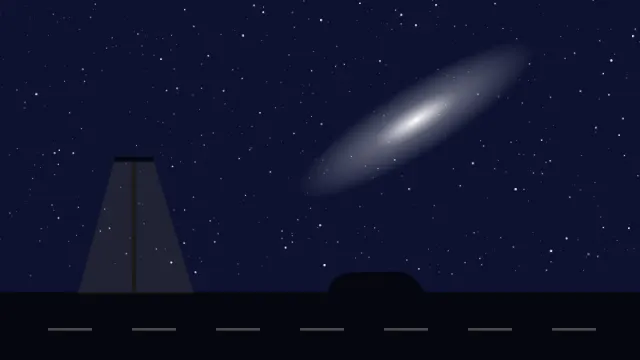
Go outside on a clear night and you can make an observation that took astronomers about three hundred years to fully explain, which is that it gets dark.
My juniors roll their eyes at this. The sun is on the other side of the planet, Mr. A. Sure. But there are stars out there, and an awful lot of them, and if you follow that thought carefully for about ten minutes you end up somewhere alarming.
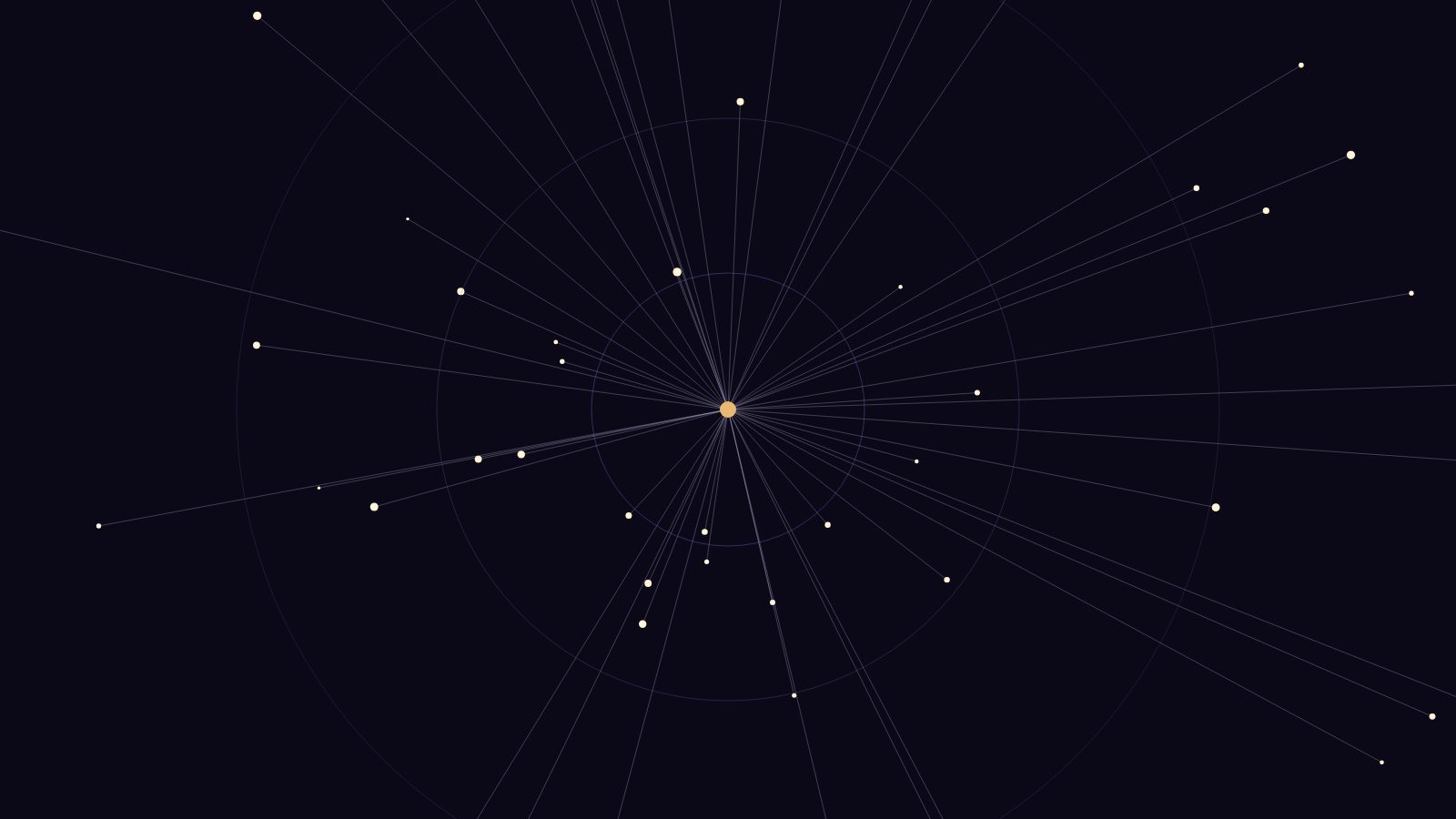
Picture the universe the way most educated people pictured it for centuries: infinite, eternal, and sprinkled with stars more or less evenly in every direction. Draw a shell around the Earth, 100 light-years out and one light-year thick, and count the light you get from all the stars in it. Then draw a second shell at 200 light-years. Each star out there looks a quarter as bright, because light spreads over area and doubling the distance quadruples the area. I do this in class with a lamp and a meter, and it comes out right about half the time. But the second shell has four times the surface, so it holds four times as many stars. The two effects cancel exactly. Every shell sends you the same amount of light as every other shell, and you’ve assumed an infinite number of shells.
Nearer stars would block some of the farther ones, so the answer doesn’t come out to literally infinite. What you get is a sky with no gaps. I take kids out to Vandermolen’s woodlot east of town to make the point. Stand in a small patch of woods and you can see daylight between the trees. Stand in a big enough forest and every line of sight ends on a trunk. In that universe, every line of sight ends on the surface of a star.
The sun covers about one two-hundred-thousandth of the sky. Replace the entire sky with sun, and noon gets about 200,000 times brighter, and so does midnight.
This is called Olbers’ paradox, after Heinrich Olbers, a German physician and astronomer who wrote about it in 1823. Johannes Kepler had already been worrying at it two centuries before him. It is named for someone who wasn’t first, which is my favorite tradition in science.
Olbers’ own answer was dust. Something out there absorbs the light. It sounds fine, and I taught it as a live option my first year in the classroom, until a kid named Anh asked me where the dust put all that energy. Over an eternity the dust heats up until it glows as brightly as the stars behind it, and you’re back where you started. I went home and read for a while.
The real answer is a clock. The universe has been around for about 13.8 billion years, and light moves at a finite speed, so we only receive light from a finite region. Do the estimate for how far a typical line of sight would have to run before it landed on a star, and you get something like 10^23 light-years. That’s trillions of times farther than the edge of everything we can see.
Stars also don’t last. Our sun gets about ten billion years. Even if you could wait, the first stars would be dead long before the far ones filled in the gaps, and there isn’t enough energy in all the matter there is to light the sky up that way. The expansion of the universe weakens the distant light too, and people often name that as the main answer, but it’s the smaller effect.
So the dark you see is a measurement. Every gap between the stars is a place where the light has not had time to arrive. You can establish that the universe had a beginning, or at least that its starlight did, using nothing except your eyes and some stubbornness.
Those lines of sight do end on something. Run one back far enough, to about 380,000 years after the start, and you reach a time when the whole universe was a glowing plasma at about 3,000 kelvin, opaque, roughly as hot as the surface of a cool red star. Every direction you look ends on that wall. Olbers’ forest is real, and you can’t see it only because the expansion of space has stretched its light by a factor of about 1,100 since it left. It now arrives as microwaves, at 2.7 kelvin. The sky has been glowing this whole time, in a color we don’t have the eyes for.
My father drove a milk route out of Ansel for thirty-eight years, which meant he was up at 3:30 every morning of my childhood. If the sky was good he’d come wake me, and we’d sit on the tailgate for ten minutes in our coats before he left. He knew no physics. He called Orion’s belt the Three Brothers and got most of the rest wrong too. As far as he was concerned the dark was just what you had left over when you took the stars away, and he liked it fine.
He died four years ago in March, a little before four in the morning, at the county hospital. I drove home the long way and stopped at the turnoff on County Road 9, where the fields open up, and I got out, because that was the hour and it’s what we did at that hour. Vega was high in the east. Scorpius was hanging over the grain elevator.
I knew exactly what I was looking at. A bright sky belongs to a universe that never started and has nobody in it, no tailgates or milk trucks, and I knew that too, and I’m telling you it helped about as much as you’d expect.
I stayed maybe ten minutes, the usual amount. Dawn was still a couple of hours off, and there was nobody I could call yet, so I got back in the truck.